How much does it cost to turn my house into a duplex in BC?
An up and down duplex conversion runs $280,000 to $420,000, and a side by side duplex runs $380,000 to $580,000. If you only want a legal secondary suite rather than a full duplex, that runs $90,000 to $160,000.
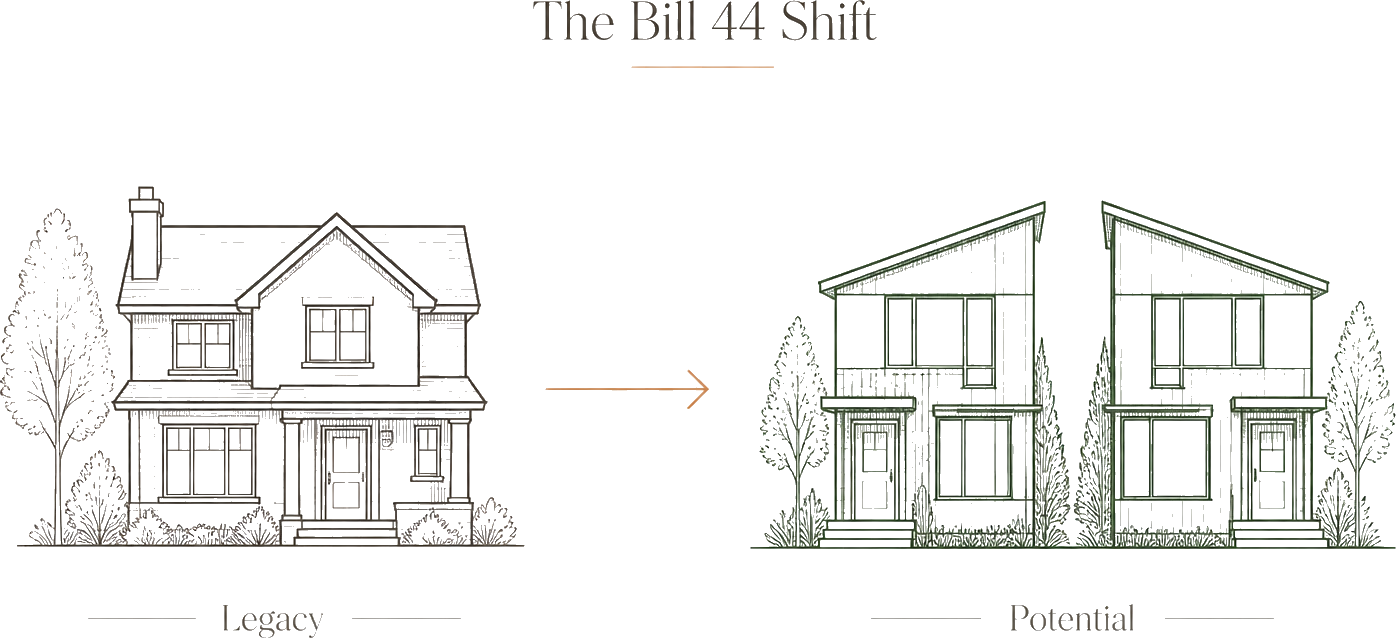
Three levels of work, and the trade off in each
The price follows how far into the building you go, so start by deciding which of these three you actually want. Each one buys you something different and costs you something different.
- Legal secondary suite, $90,000 to $160,000. The cheapest route and the least disruptive, but you end up with one home and one subordinate unit rather than two equal homes.
- Up and down duplex, $280,000 to $420,000. Two full homes for the least structural change, at the cost of one household living above the other and sharing a horizontal floor.
- Side by side duplex, $380,000 to $580,000. The most privacy, two front doors at ground level and a yard each, and the most expensive because walls and services all move.
What to go and check before you call anyone
You can narrow your own likely range in an afternoon, without a builder present. What you are looking for is whether the systems in the house can be kept or will have to be replaced, because that is the single biggest swing inside a level.
- Open the electrical panel door and read the rating and the age. An old undersized panel means service work before anything else happens.
- Look at where the kitchen and bathrooms sit relative to each other, upstairs and down. Stacked plumbing is cheap to work with, plumbing scattered across the plan is not.
- Find out whether the house is on municipal water and sewer, because a lot without both is outside what Bill 44 permits entirely.
- Pull your title search and read it for covenants. A registered covenant can quietly restrict the lot, so its wording sets the limits of the conversation before any plan is drawn.
- Look at the basement as a place someone would live: a unit counted as self contained has to have its own entrance, kitchen, bathroom and sleeping area, and meet local codes and permits.
What commonly moves the number after the first conversation
Two things, and they are worth expecting rather than being surprised by. The first is anything that only becomes visible once a wall is open, which is why scope is agreed in writing with allowances set for those items rather than a single flat figure.
The second is the municipality. Permit timelines are set by the city rather than by us, so a schedule is given after the scope is settled instead of a number promised before it. Anything that changes after that point is a change order you see and approve first, with a weekly update, so it does not arrive at the end as a total.
How the arithmetic compares to buying a condominium
Start from what a whole house costs here, which is roughly $1.1 million to $1.4 million. Fold the conversion in, divide the property between two households, and one household's share sits around $550,000, which undercuts a large share of the condominium market across Metro Vancouver.
The honest comparison is not price alone. Against a condominium you gain a yard and the floor area of a house, and you take on a co-ownership agreement, a build, and a second household to agree with. Against staying put you gain a second home on the lot and lose the use of part of your own.
Two programmes that can offset part of the cost
Check your eligibility against these before you set a budget, because one of them is once in a lifetime per person and the other changes how you finance the work.
Take the Multigenerational Home Renovation Tax Credit first. It is federal, it is refundable, and it returns 14.5 percent of eligible work up to a $50,000 ceiling, which the Canada Revenue Agency currently puts at a maximum of $7,250 back. Practically, three conditions decide it: the relative you are building for is 65 or older, or 18 to 64 and eligible for the disability tax credit; the unit is genuinely self contained, with its own entrance, kitchen, bathroom and sleeping area, and meets local codes and permits; and neither of you has already claimed a renovation for that person, since only one can be claimed in their lifetime.
The CMHC refinance programme for building secondary suites is the financing side. The improved value of the property, not today's value, is what you borrow against, and the ceiling on that is 90 percent. To qualify the property has to be worth less than $2 million and hold no more than four units, at least one borrower needs a credit score of 600 or better, and the amortisation can be stretched as far as 30 years. Two conditions then constrain how you use the result: one of the units has to house you or a relative, rent free, and letting the new suites short term is ruled out.
Neither programme is fixed in place. Read the terms here as the version that was current when this page was written, and have an accountant and a mortgage professional confirm where they stand for your own situation before you count on either.
Sources: Canada Revenue Agency · CMHC
Credentials
One next step
Get the number for your house
Tell us about the property you own and Cam comes back with what your lot allows. Scope is agreed in writing before anything starts.